Hire anywhere, work anywhere? Can HR design for that?
Lukas Wallrich · Birkbeck, University of London
Visiting Lecturer · SWUFE · May 2026
Today, in three parts
Three routes to a global workforce
Send, hire, or buy. Each raises different HR questions.
Working across distance
Time zones, the meeting tax, async vs sync ... and what fair pay looks like in distributed teams.
Your presentations, one week out
The brief, the 9-minute shape, delivery, and group work / Q&A time.
Chunk 1 of 3
Send, hire, or buy
Three routes to a global workforce, and the design questions each one forces on HR.
Paired Share配对分享04:00
Discuss
Think of a company outside Chengdu — anywhere in the world — that you might like to work for. What would it be like to work for them from here? What would they need to figure out, and what would you?
What to do
Pair with the person next to you.
About 90 seconds each way.
Three routes to a global workforce
Send
A person from HQ goes to the host country. (This was last session.)
Hire
A person already there joins your firm, even if you have no legal entity in that country.
Buy
You acquire a firm and inherit its people.
Three different sets of questions for HR. Today's session is mostly about the second and third.
Both sides have to figure something out
Company side
Where is the legal employer? Who runs payroll? What labour law applies? Are we creating a taxable presence in that country?
Employee side
Where do I work legally? Where do I pay tax? What status do I hold? Who do I go to when something goes wrong?
The "we just hire them" picture hides a lot of design choices. Most of them sit with HR.
The Employer-of-Record split
Operational employer (your firm)
Daily work. Performance reviews. Line management. The team chat.
Legal employer (e.g., Deel)
Local contract. Payroll. Statutory benefits. Tax compliance. Statutory grievance route.
Two employers in one job. Most everyday HR sits on the left; almost all the compliance sits on the right.
Nomad visas solve immigration, not compliance
What they are. Residence permits for people working remotely for a foreign employer (UAE, Thailand, Spain, Portugal).
What they don't cover. Corporate tax presence, payroll, social security, working time, and data still depend on the employer's local position.
The adjacent trap. A "contractor" who works only for you and takes daily direction may be reclassified as an employee - rights & taxes ↑
When you buy a workforce: Lenovo–IBM, 2005
What Lenovo did
About US$1.25bn plus ~$500m in liabilities. ~19,000 staff combined, ~10,000 from IBM. English as the corporate language; HQ in New York; top-team power shared .
What HR inherited
Identity, pride, a sense of where people belonged. Would IBM engineers stay? Would IBM customers trust the brand under its new owner?
Group Task小组任务09:00
Three roles
A. Engineer in Chengdu, hired by a Paris firm via Deel. B. Designer in Phuket on a Thai nomad visa, for a US start-up via Upwork. C. IBM engineer in Raleigh, the morning Lenovo's deal closes.
For each, agree:
Who is your employer?
When something goes wrong, who do you call?
What would make this feel like you belong?
Report-back反馈
Share
For a given role, where did belonging come from, or where was it missing?
You could also share
Something your group disagreed on.
Specific challenges HR needs to address for each role.
We've chosen where the employer lives, and what kind of contract frames the relationship.
Next: what happens once these people have to work as a team.
Chunk 2 of 3
Can they work as a team?
Distributed work — time, voice, and pay.
Paired Share配对分享04:00
Pick one
Real. A time you actually worked with someone who wasn't in the room. OR hypothetical. Joining a six-person team where you're the only one in Chengdu; the others are in London, Dubai, São Paulo.
What did you find harder than expected? What might be hard?
What to do
Pair with the person next to you.
About 90 seconds each way.
Hybrid works. Fully remote is harder.
Trip.com. Shanghai, 2021–22 randomised trial of 1,612 graduate employees. Two days at home per week cut attrition by about a third, with no hit to performance reviews or promotions .
Still contested. Plenty of firms are betting the other way — Amazon ordered staff back five days a week from 2025. The balance between remote and in-person is far from settled.
Employee demand is strong - hybrid likely to stay, with specific HR policy challenges.
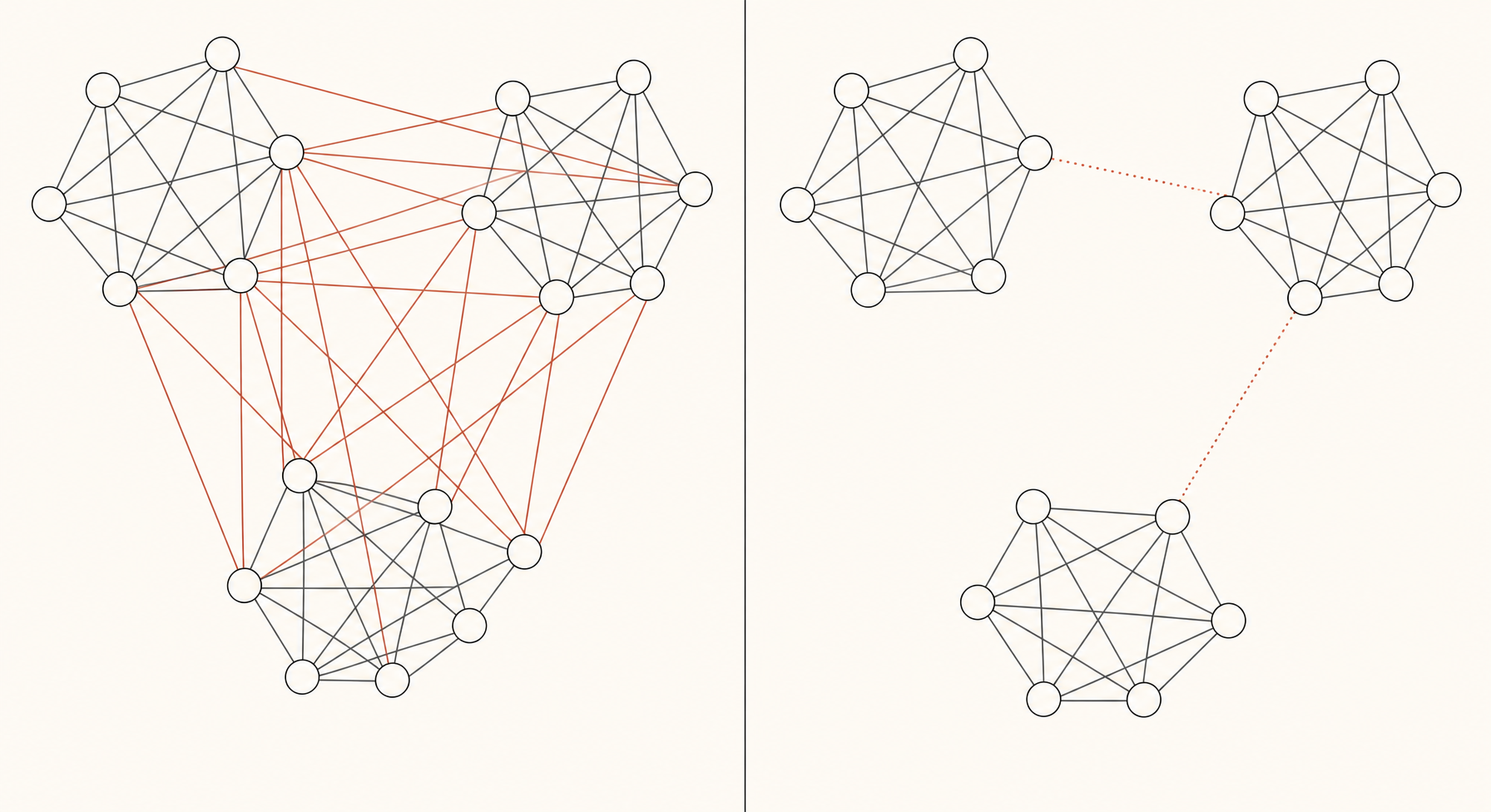
What happens to employee connections when a company goes fully remote?
Fully remote weakens the ties between teams, not within them
Left: before. Right: after the firm went fully remote. — 61,182 Microsoft employees over six months.
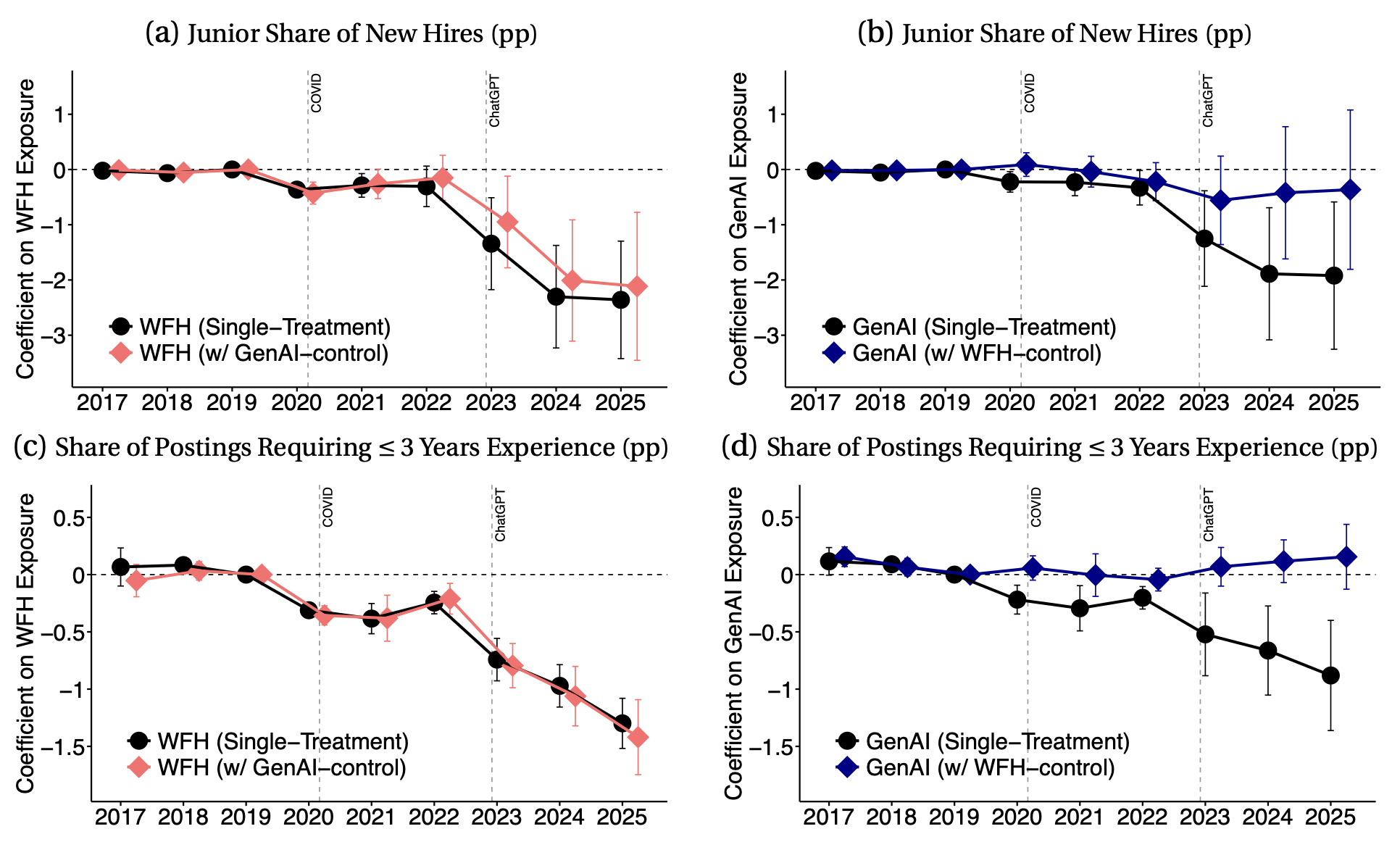
Does remote work make it harder to get on the career ladder?
Junior hiring has fallen since 2022, and the headline story blames AI. But AI-exposed jobs and work-from-home jobs are almost the same jobs. Each panel: black = one factor alone; colour = the same factor once the other is held constant. Working-from-home stays predictive (a, c); the AI effect collapses to near-zero once WFH is accounted for (b, d).
The upside: remote work unlocks geocentric staffing
Last session: send your own. Ethnocentric staffing — fill the key roles from headquarters.
Now: hire the best, anywhere. When work no longer needs an office, location and nationality stop gating the talent pool — geocentric staffing, from last session's map.
The catch. A geocentric team is a distributed team — across time zones, languages, and labour law. The prize and the problem arrive together.
The meeting tax falls on the edges
Time zones push work into evenings and mornings. People at the edges of the spread time-shift to take part.
The burden is uneven. Female employees, and employees in stricter-hours regimes, time-shift less .
The result is fewer informal moments and less visibility for the people who can't shift.
"We'll accommodate your time zone" costs some people more than others.
Once everyone has Slack, what still needs to happen live?
Status, handover, documentation.Usually async by default.
Ambiguity, disagreement, hard calls.Still better live.
Trust and onboarding.Live where possible; recurring async check-ins in between.
Having the tools isn't what makes a distributed team work. The structure of the network — the bonding and bridging ties — does (Heubeck et al., 2024).
Group Task小组任务14:00
Scenario
A product-launch team in Chengdu, London, Dubai, and São Paulo. Six weeks to ship. They need decisions, customer handovers, and to onboard one new junior in São Paulo. Design their operating system on one sheet of A4.
What to do
Decide what your team must agree on — e.g. sync vs async, the tools you use, meeting times, who decides what.
Keep it to one page.
Pick a spokesperson for the report-back.
Report-back反馈
Share
What key design ideas did you follow?
You might also address
Who ends up with the worst hours, and how did your plan handle it?
Which sync/live moments did your plan protect?
Same role, three cities: what is fair pay?
Local market
Pay matches the going rate in each city. (Google, Meta — historical practice.)
Cost-of-living adjusted
A published formula: a base rate times a location or cost-of-living factor. (GitLab, Buffer.)
Single global rate
The same rate everywhere. People in cheaper cities keep the surplus. (Basecamp / 37signals.)
Local rate follows each city; cost-of-living protects what pay buys at home; one global rate treats everyone alike. Three ideas of what's "fair".
"Equal pay" — equal in what?
To the individual"fair to me?"
To the team"fair between us?"
Same numbersame gross pay
Can I even live on this here?
Equal on paper — simple, transparent.
Same standardof living
I can afford what my peers can.
Same job, different numbers.
And "same number" splits again: equal pre-tax pay rarely means equal take-home, once tax regimes differ.
That's the design work.
Next: your presentations.
Chunk 3 of 3
Your presentations, one week out
What the brief asks for, a workable 9-minute shape, and time to use as a group.
What the brief asks for
Specific evidence about this firm. Generic claims about "Country X culture" don't score.
At least one framework, theory, or research finding — applied with awareness of its limits.