Aggregate-level: designed for clusters and countries, not for diagnosing the person in front of you .
Today: where the cluster map leaks, and what's specifically distinctive about leadership inside Chinese workplaces.
Same cluster, three leadership clash points
300 Chinese + 300 Japanese employees · interviews at a Shanghai subsidiary of a Japanese firm
Chinese employees expected
Transactional clarity. Clear individual goals, fast appraisal, transparent pay-performance links.
Decisive leaders. Make the call in the room, not "let me check with Tokyo."
Real delegation. Delegation read as trust and a chance to develop.
Japanese managers brought
Process and collective good. Cooperation, fairness, company-wide success over individual reward.
Consultative decisions. Listening, then escalating to HQ — read as indecision, costing legitimacy.
Plan-and-control. Delegate only when the result is predictable.
Same Confucian cluster — but a fluid labour market and short-term contracts reshape what Chinese employees expect from a leader.
Paternalistic leadership is three things, not one
Authoritarian
威权
Benevolent
仁慈
Moral
德行
…and they don't all work the same
✓
Benevolent 仁慈
Positively related to innovation (r ≈ .40), task performance, OCB .
✓
Moral 德行
Positively related to innovation (r ≈ .33), task performance, OCB.
✗
Authoritarian 威权
Negatively related to innovation (r ≈ −.15) and to task performance; positively related to counterproductive behaviour.
"Paternalism works in China" — partly true, partly false. The benevolent + moral parts work. The authoritarian part doesn't.
Younger Chinese workers: selective, not anti-hierarchy
Strongest preference
Moral leadership. The most preferred style among relatively young Chinese professionals .
Also receptive to
Transformational leadership. "Traditional Chinese" and "Western modern" leadership aren't experienced as opposites — they sit together comfortably for young workers.
Least preferred
Authoritarian — but not rejected. Negative effect on innovation is small (r ≈ −.15) and stable across publication years . No clean "post-90s rejects authority" trend in the data.
Growing openness, distinct preferences.
Younger Anglo professionals: coach me, don't manage me
Most wanted
Hands-on coaching. Managers who proactively scaffold development. "No news is good news" was rejected by every Gen Z professional in the sample .
Also expected
Personable warmth. Managers who ask about the weekend, not only the deliverable. Those without it felt "more like a task than a person."
Least preferred
Distant authority. Annual reviews; vague criticism; managers who wait to be approached. Reject the "earn your way to a relationship" model.
Coaching with clarity — not laissez-faire.
Quick Sort小组任务06:00
· in pairs
Six behaviours · one factory · which style?
Sort each into one of: authoritarian · benevolent · moral · charismatic / value-based · participative · self-protective.
1During Spring Festival, she personally visits the night shift and asks each worker about their family.
2He decides the production schedule alone; line supervisors execute, are not consulted.
3She refused a longstanding supplier kickback and said publicly the firm would not do business that way.
4He opens every quarter with a long talk about why the firm's mission matters, and means it.
5She asks each function head's view before making a strategic call, then decides.
6He keeps the executive floor closed to non-senior staff and avoids the shop floor.
Label each, then pick a spokesperson for a 30-second share.
Report-back反馈
Share
Was anything difficult to classify? Why? Any behaviours you particularly liked / disliked?
Half of those behaviours are about face: who is seen as what, by whom. That's the next chunk.
Chunk 2 of 3
Face, voice, and the leadership mismatch
Face shapes the form of dissent, not the fact of it
Other-face 他人面子
Concern for the manager's face produces indirect voice — questions, suggestions, after-meeting messages .
Self-face 自我面子
Worry about how I will be seen produces silence, delay, or going around the channel.
Same person, different counterpart
Chinese employees' conflict-avoidance was stronger with Chinese than with Western managers . Face is relational — the audience changes the form.
When silence is structurally encouraged
324 employees · 16 state-owned manufacturing enterprises · China ·
The study
Authoritarian leadership positively associated with employee silence.
The effect runs largely through psychological safety — the shared belief that the team is safe for interpersonal risk-taking — and through workers' sense that their role matters.
Why it matters here
Authoritarian leadership doesn't only mute disagreement: it produces unraised concerns.
Quality risks, safety risks, market signals that never reach the manager because raising them is structurally unsafe.
The fix isn't "be more participative." It's redesigning the channel so the cost of speaking up is lower than the cost of staying silent.
Diagnostic Case小组诊断groups of 4–5 · ~17 min
The case
Wei is country manager of a Chinese tech firm's UK office in Manchester. She joined the company 12 years ago in Shenzhen; this is her first overseas posting. ~80 staff, mostly British. Six months in, voluntary resignations among UK middle managers have risen. Three things she has done:
Monthly all-hands talks on company values, mission, and long-term commitment. ~45 minutes each. Mandatory.
Deep one-to-one care. Asks reports about their parents and partners by name. Mooncakes to every manager at Mid-Autumn; paid personally for one manager's wedding photographer. Most appreciated this. One filed an HR complaint about "boundary-crossing."
Contract approvals over £50k pause while she "consults with Shenzhen." Some come back in 48 hours; some take a fortnight. UK sales head: Wei "doesn't have real authority here."
Diagnostic Case · Go小组诊断15:00
· groups of 4–5
Your task · 3 rows × 3 columns on A3
For each of Wei's three behaviours: diagnose · ask · redesign.
On A3 paper
Diagnose each behaviour. Label with one concept from chunks 1–2 (authoritarian / benevolent / moral / transformational / participative / self-protective / other-face / self-face).
One question you'd put to Wei before she changes anything.
Redesign each: keep what Wei is trying to achieve, change how it shows up. One sentence per redesign.
Working小组诊断 · 进行中15:00
· groups of 4–5
Monthly all-hands talks on company values, mission, and long-term commitment. ~45 minutes each. Mandatory.
Deep one-to-one care. Asks reports about their parents and partners by name. Mooncakes to every manager at Mid-Autumn; paid personally for one manager's wedding photographer. Most appreciated this. One filed an HR complaint about "boundary-crossing."
Contract approvals over £50k pause while she "consults with Shenzhen." Some come back in 48 hours; some take a fortnight. UK sales head: Wei "doesn't have real authority here."
Diagnose · Ask · Redesign — one row per behaviour on your A3.
Report-back反馈~8 min
Share
Three groups share one row each — diagnosis · redesign · question. Different behaviour each.
How we'll do it
Group 1: monthly all-hands
Group 2: deep one-to-one care
Group 3: pricing consultation with Shenzhen
Class call-out: any group with a different diagnosis for the same behaviour?
What the case teaches
The content was mostly right. The form was off. Wei's transformational, moral, and benevolent moves are well-evidenced as effective in Chinese (and UK) workplaces. The mistranslation is in cadence, channel, and what counts as authority.
Silence isn't the absence of voice, it's voice in another channel. Resignations, conversations with the line manager but not with Wei, the HR complaint that surfaced only after weeks.
The fix isn't "be more British" or "be more Chinese." What the room sees diverges more than what people actually need.
Next chunk: when you sit across the table from someone with different assumptions about what to share, and when.
Chunk 3 of 3
Negotiation
We're going to play first. Theory after.
Set-up准备~2 min
In a moment
Two scientists. Lives at stake. One orange harvest. Eight minutes.
Pair up. Pick A or B. Open the brief link on your phone with the access code shown next. Negotiate in any language you both speak.
Negotiation谈判08:00
· in pairs
The situation
The world's last harvest of Ugli oranges (3,000) is the only source of a compound two research teams need to save lives — for different projects. The grower: "10 yuan per orange. Decide between yourselves who buys the lot. I'm not refereeing." Sort it out.
What to do
Open the brief link · enter your code · read silently, ~90 s.
Negotiate in any language you both speak. Focus on the person across from you.
Reach an agreement, or walk away with no deal.
swufe-cchrm.pages.dev/b2
Dr A4137Dr B8265
What predicts joint gains, across cultures
The headline
Across cultures, what predicts joint gains is information sharing — clear admissions of priorities, or questions that surface them. Not "national style." Not "directness vs indirectness" per se (Adair et al., 2004).
The stereotype-breaker
In face-to-face negotiations between PRC and US negotiators, Chinese negotiators asked more questions and interrupted more frequently than American negotiators. Both sides did better when focused on problem-solving .
What the evidence does not say
"Chinese negotiators stay silent" is not what the data show. Hong Kong Chinese in the six-culture study were not as indirect as researchers predicted either. The probing move is reliably valuable across cultures.
The blocker is almost never "directness" — it's running out of time, or never asking.
Fishbowl鱼缸观察 · in English08:00
· 1 pair plays
A different scenario
The factory floor and the design studio. A Chinese manufacturing supervisor and a European product designer must agree on next month's production schedule. The supervisor needs a stable line and resists late spec changes. The designer needs to push an iteration before a trade show.
Observers — watch for
a
What assumption is each side making?
b
When does someone ask a question?
c
When does someone share information?
d
What would you ask next?
swufe-cchrm.pages.dev/b2
Supervisor5083Designer9472
What made information move — or not?
Question-asking is the active ingredient. Both rounds: the move that mattered was someone asking what the other side actually needed.
Indirect can also work — when the other side listens. An offer that splits the orange differently is itself a question. A counter-proposal that drops a spec change is itself an admission of flexibility.
Cultural style matters less than information architecture. Time pressure, the absence of a question, the absence of a way to ask without losing face — these block joint gains.
Which round produced more information sharing?
If you read one negotiation book
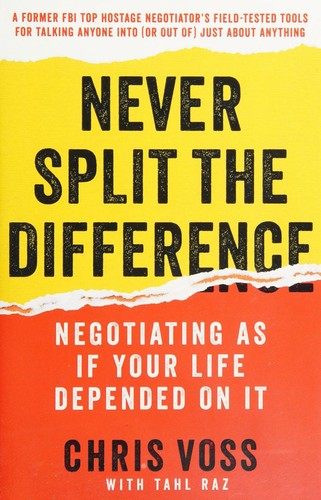
Chris Voss
1 · Grow the pie
You can always do better than splitting the difference. Ask what the other side actually needs — there's usually more to share than the visible number.
2 · Tactical empathy
Mirror their last words. Label their emotion ("it sounds like…"). We all want to feel understood — and once we do, we move.
3 · Calibrated questions
Open with "How can I do that?" or "What about this works for you?" — open questions that hand them the problem to solve with you, not against you.
Three things to take away
Leadership ideals
Travel partially. Charisma, benevolence, morality, team-orientation travel well. Participative travels less cleanly. Authoritarian is problematic, in China and beyond.
Silence
Is information. What's not said in the meeting is being said elsewhere. The HR design question is whether that elsewhere is functional.
Negotiation
Is question-asking. The biggest reliable cross-cultural finding is about information sharing. Style is the second-order question.
We'll have a negotiation practice session.
Remember what you'd like to try out differently after today.
Looking ahead
Practice
Skill 2 (negotiation role-play) coming up. Bring this session's vocabulary; tactical layer to be added.
Reflection
Session 4 prompt on the assessment page. Keep it to one specific moment you changed your mind about — in the Wei case, in the orange exercise, or in the fishbowl.
Presentations
Share <1 page problem statement in first session next week. Case briefs is on the assessment page.