Communication & feedbackacross cultures, across channels
Lukas Wallrich · Birkbeck, University of London
Visiting Lecturer · SWUFE · May 2026
Today, in three parts
Where meaning sits
And how language itself shapes what can be said.
Feedback as a cross-cultural skill
Face, attribution, architecture — and a real practice round.
Language policy is HRM
Who gets heard, in which words, on which channel.
Chunk 1 of 3
Where meaning sits, and how language shapes it
Paired Share配对分享04:00
Discuss
A time you misunderstood someone — or they misunderstood you — in a team, group project, or at work. What was not said?
What to do
Pair with the person next to you.
2 minutes each way.
I will call on 2–3 pairs to share.
The textbook model — and what it misses
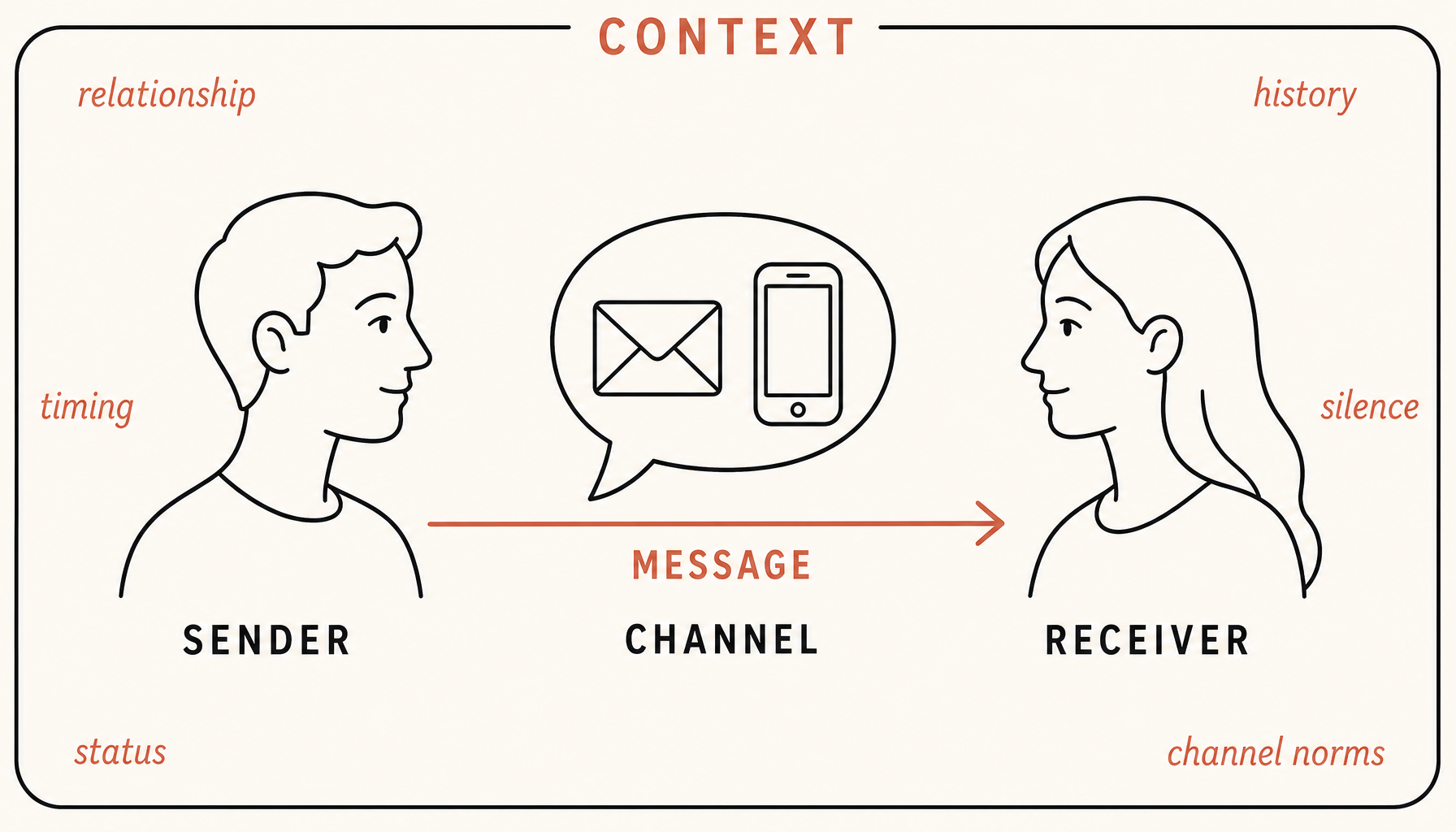
Where does meaning sit?
Low-context · 低语境 — in the words
Explicit content, definitions, written rules.
What's typed in the email body. What's signed in the contract.
High-context · 高语境 — around the words
Shared history, channel, timing, tone.
Who else is on the email. What the manager said last Tuesday.
Silence — a pause can carry agreement, doubt, dissent, or careful consideration.
Most workplace messages sit somewhere in between.
Does Hall's high-/low-context map hold up?
The classifications wobble
Kittler et al. (2011): country assignments to high- vs low-context contradict each other across studies, often resting on a single anecdote.
Meta-analysis: weak support
reviewed 224 articles. The most-cited Hall claims — especially around directness — were among the least empirically supported.
Take-away
Keep the question — "where does meaning sit?" — it travels well across teams, channels, and relationships. Drop the country league table. Same move as Hofstede.
Language itself carries hierarchy
Korean & Japanese
Every verb ending encodes the speaker's relationship to the listener. You cannot say "give me the report" without choosing a power register. Hierarchy is grammatical, not optional.
German, French, Mandarin (& many others)
Formal vs informal address forms: Sie / du, vous / tu, 您 / 你. Choosing one is a public statement about the relationship; switching is meaningful.
English
No formal/informal "you"; first-name norms widespread; titles often dropped. Often experienced as neutral and modern. That neutrality is itself a position.
Most languages mark hierarchy. English is unusual in how little it marks.
"Professional" English is not neutral
Self-promotion norms
CV conventions — lead with achievements, quantify outcomes, active verbs — reflect Anglo norms. The same prose can read as boastful in another register.
Email & reply norms
Short paragraphs, "Hi X," quick "thanks." Different from Mandarin or Japanese registers that often lead with context, season, or relationship.
Address erasure
First-name norms strip cues that 总 / 经理 / 老师 / Professor / Direktor carry. Status information that other languages encode gets silently dropped.
When a firm "goes English," the English brings a register, not only a vocabulary.
Group Task小组任务10:00
· 4 per group
Your task
Three workplace messages. Read each one twice — once as a senior trusted colleague, once as a brand-new junior. In one line each: does that make a difference?
(a) WeChat from your line manager, Sunday evening · you presented to the team on Friday
"see me tomorrow."
(b) Director two levels above you, in a project meeting · you just pitched a new approach
"Interesting approach."
(c) Email sign-off from HR · last week you flagged a colleague's behaviour
"We'll discuss."
What to do
Paper grid: message · senior colleague · new junior.
For each message and recipient: what do you understand by it? Why?
Pick a spokesperson for a brief share-back.
Report-back反馈30s per group
Share
What made the biggest difference? Medium, tone, relationship?
Those were workplace messages in general. Next: what happens when the message is explicitly about your performance.
Chunk 2 of 3
Feedback as a cross-cultural skill
Feedback positions someone, as well as informing them
Face — how a person is being seen: status, credibility, respectability, relational standing.
Criticism is never only information. It is also a (public) statement about the receiver.
This is true everywhere, not only in China — though the registers differ.
Four ideas about feedback
Feedback lands when face is saved
Specific, face-saving feedback drives learning. Vague or face-threatening feedback gets defended against, not absorbed.
Directness is a style, not a moral virtue
Clear ≠ harsh. Tactful ≠ dishonest. Two separate questions.
Developmental over evaluative
Developmental feedback predicts work-role performance and thriving at work in Chinese samples .
Strength-based feedback empowers
Naming what someone does well lets them build on it, rather than converge on a single template. Especially valuable in loose/individualist cultures.
A key framework: SBI
Situation
When and where the behaviour happened. A specific moment, not "always" or "in general."
Behaviour
What you observed. Concrete terms. No speculation about motive.
Impact
What effect it had, on you, on the work, on others.
Not SBI"Your reports are too long."
SBI"In Tuesday's project review, the update section ran to 6 pages, and we ran out of time to discuss the open questions, which were the part the client cared about."
One tool, not the only one. You'll use it when we practice.
When workers evaluate their managers — a China field experiment
2016–2017 · Chinese passenger-vehicle plant · 1,250 workers across 76 production teams · Cai & Wang (2022), Quarterly Journal of Economics
The intervention
Anonymous monthly paper forms. Workers scored their managers across five dimensions.
Half of teams treated. Worker scores counted for 20% of the manager's monthly review. Aggregated results posted publicly on the team board.
What changed
Workers in intervention teams were 6.2 pp less likely to quit — a 50%+ relative reduction.
Team KPI attainment rose 2.3% above a 97% control baseline.
Workers reported higher happiness and life satisfaction.
Managers were reported to encourage more, criticise less, and respond more on WeChat.
The architecture — anonymity, cadence, structure, paper — did the work. Not "more Western" or "more Chinese" feedback.
Group Task小组任务08:00
· in pairs
Your task
In pairs, draft one piece of SBI feedback for me about a specific behaviour you have observed in Sessions 1–3. Volunteer to read it aloud, or hand it in and I will read it.
Situation when and where
Behaviour what specifically
Impact what effect
What to do
Discuss in pairs. Pick one specific behaviour. Use SBI.
Write on paper. Keep it brief, 3-5 sentences.
Volunteer to read your note, or pass it forward.
What just happened
The notes that may change my behaviour were specific — a moment, a behaviour, an impact.
The option of anonymity removed face risk (I hope). That's the architecture point.
The framework gave you a way in. The relationship and the room shaped what got said.
Next chunk: who decides the language all of this happens in?
Chunk 3 of 3
Language policy is HRM
Working language decisions are "political"
A working-language policy redistributes…
Opportunity
Who gets put on global projects, and who doesn't.
Status
Whose ideas are heard at full speed, without disfluency or translation loss.
Cognitive load
Who does two jobs at once: the work, and the translation.
Voice
Who can challenge a superior, and who decides it isn't worth the difficulty.
Tools can shift the load: translation, captions, LLMs. But who builds them, in which languages, with whose accents? What gets lost in translation?
The cost of working in a second language
Cognitive load
Even high-proficiency speakers process more slowly, miss nuance, and make more conservative choices when working in L2.
Status compression
Fluency becomes a proxy for competence. The most articulate voice in the meeting is heard as the most expert one.
Self-silencing
Non-native speakers ask fewer questions, push back less, and contribute less in unstructured meetings, even when their views matter most.
A measurable HR cost, borne unevenly . Can be overcome with lots of practice — but functional bilingualism is hard.
Rakuten: costs and benefits of an English mandate
March 2010 mandate · 5-year study, 650 interviews across 8 country sites · 3,000+ surveys · 20,000+ pages archival · Neeley (2017)
The mandate
CEO Mickey Mikitani: company-wide English — "Englishnization." All employees, all roles.
Initial expectation: learn it yourself.
Early progress so poor that "learn it yourself" became "learn it with company-paid time, classes, and tools."
What it cost, what it bought
Supported international acquisitions, faster post-merger integration, a broader global talent pool.
Also: documented stress, demotion, and self-silencing in the transition.
Three populations took shape in the workforce: Japanese staff forced into English (linguistic expats), Anglophones embedded in a Japanese workplace (cultural expats), and those facing both at once (linguistic-cultural expats).
A universal mandate is the most expensive way to do this. It can work. The cost is mostly paid by individual employees.
Huawei: a different model for internationalisation
2020 policy · cross-cultural training infrastructure · WeLink translation tooling
Functional, not universal
Only Chinese employees in roles that face global markets are required to use English with certification. Most Chinese employees never need it.
Plural, not English-only
In non-English-speaking regions, certification can be in the local language. A Huawei manager in Germany can certify in German.
Infrastructural, not aspirational
Multilingual tooling built in: WeLink Translate supports 60 languages. Mandatory cross-cultural courses for Chinese expatriates; onboarding courses for non-Chinese new hires.
By end-2020: 8,300+ Chinese employees and 2,200+ Chinese managers certified; operating in 170+ countries.
Group Task · Stage A小组任务10:00
· 4 per group
Your task
Design a one-page language-and-feedback policy for your one assigned scenario. Pick an approach, plus a risk & mitigation.
Scenario 1
European retailer in Chengdu
180 staff. UK HR director wants quarterly feedback delivered in video calls. Local managers say corrective feedback should be private and in Chinese.
Scenario 2
Chinese EV supplier in Hungary
Shenzhen HQ wants written project reviews in English. Local supervisors say shop-floor coaching only works in Hungarian. Real-time chat translation available but lossy.
Scenario 3
Beijing tech firm with global teams
No formal English-only policy. Teams across Singapore, Dublin, San Jose, with some complaints about exclusion. In-house interpreters; mixed Lark, WeChat, and English email.
You might consider
1 Meeting language
2 Written feedback language
3 Appraisal-form language
4 Informal check-ins
5 Upward voice channel
6 Tools — translation, captions, summaries
Pass-on Critique · Stage B互评05:00
· 4 per group
Your task
Send one person to another group. They present your policy; the host group gives one strength and one question or area to improve.
As you listen, ask
Who gains voice under this policy? Who loses it?
What happens to a brand-new junior employee?
Is the cognitive load shared, or does it fall on one group?
Are tools effectively used? Are there any risks?
Visitor: carry the feedback back to your group.
Report-back反馈~3 min
Share
Three groups present & raise the question
How we'll do it
I pick one group per scenario
Original group: 1 minute — your approach.
Visitor: 30s — the strength and question you brought back.
Original group: any initial response?
Three things to take into Session 4
Communication
A system, not just words. Content, channel, relationship, and the language itself all carry meaning.
Feedback
An architecture. The system around the comment — anonymity, cadence, framework, follow-up — matters more than any single comment.
Language policy
An HR decision. Choosing a language chooses a power structure. It also chooses who benefits most.